Famous Black Beekeepers
When people picture a beekeeper, the image that often comes to mind is a stereotypical one: an older white man in a veil, tending hives in a rural field. While that image has become familiar, it tells only a small part of the story. The history of beekeeping in the United States has also been shaped by Black educators, scientists, and agricultural leaders whose contributions are rarely highlighted. Here are four influential Black figures whose work helped shape our understanding of bees.

Margaret Murray Washington (1865–1925)
Champion of Beekeeping Education for Black Women
Margaret Murray Washington was an educator, reformer, and the “lady principal” of Tuskegee Institute. While she is often remembered for her leadership in women’s education and club work, she also played a pivotal role in introducing beekeeping into formal training programs for Black women.
After traveling to Europe in the late 1890s, Washington observed women participating in horticulture and beekeeping and recognized the economic potential of these skills. Upon returning to Tuskegee, she helped establish organized beekeeping instruction for women, including the formation of what became known as the Lady Beekeepers Club. This group gained national attention and demonstrated that beekeeping could provide both income and independence.
Washington’s work reframed beekeeping as a practical, respectable vocation for Black women at a time when their economic opportunities were severely limited.

George Washington Carver (1864–1943)
Advocate for Ecological Agriculture and Pollinators
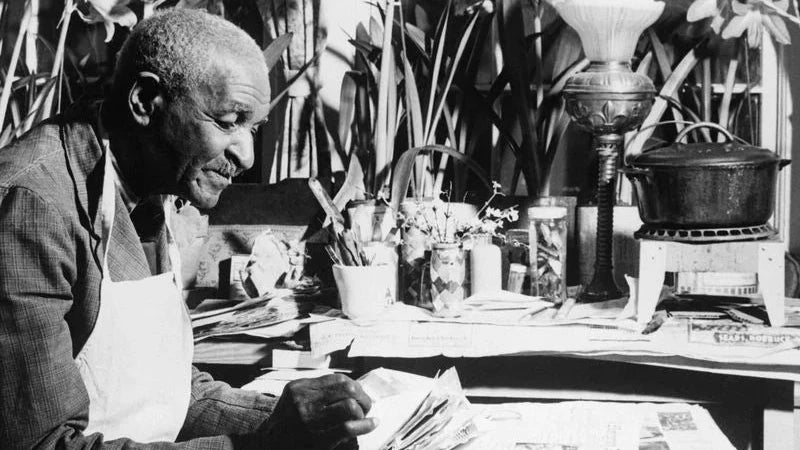
George Washington Carver may be best known as "Mr. Peanut" for his work with peanuts, crop rotation, and soil conservation, but his influence also extended to beekeeping. As a scientist and educator at Tuskegee Institute, Carver emphasized the interconnectedness of nature and the importance of working with natural systems.
Carver encouraged diversified farming practices, including beekeeping, as a way to improve crop yields and generate additional income. He recognized bees as essential pollinators and promoted practices that supported both agricultural productivity and environmental balance. Through his bulletins and demonstrations aimed at poor and rural farmers, Carver helped elevate the role of bees within sustainable agriculture.

Charles Henry Turner (1867–1923)
Pioneer of Honey Bee Behavior Research
Charles Henry Turner was one of the earliest entomologists to conduct rigorous experimental research on honey bee behavior. A zoologist and educator, Turner published dozens of scientific papers at a time when Black scholars were largely excluded from major research institutions.
Turner’s work challenged the idea that insects operated purely on instinct. Through carefully designed experiments, he demonstrated that honey bees could learn, distinguish patterns, and respond to visual cues — discoveries that anticipated later breakthroughs in animal cognition and behavioral science.
Despite holding a Ph.D. and making groundbreaking contributions, Turner spent much of his career teaching in underfunded schools due to racial discrimination. Today, he is recognized as a foundational figure in the scientific study of bees.

Lonnie N. Standifer (1926–1996)
Leader in Modern Bee Science
Lonnie Standifer was a 20th-century trailblazer in bee research and one of the most influential Black figures in modern apiculture. Trained as an entomologist, Standifer specialized in honey bee physiology and nutrition, helping advance scientific understanding of bee health.
In 1970, he became the first African American director of the USDA’s Carl Hayden Bee Research Center, the largest honey bee research facility in the United States. His leadership marked a historic milestone in federal agricultural science. Standifer also taught at several universities, including Tuskegee, mentoring students and strengthening pathways into scientific careers.
By recognizing these figures, we not only honor their individual achievements but also acknowledge the long-standing presence of Black knowledge, innovation, and leadership in the world of bees.
Interested in supporting modern black beekeeping movements that focus on community empowerment? Check out these organizations below!
Detroit Hives: Founded by Black apiarists in Detroit, Detroit Hives is a community-oriented nonprofit that uses beekeeping as a tool for urban renewal, education, and environmental justice.
- Website: https://detroithives.org
- Instagram: @detroithives
Sankofa Farms: Sankofa Farms is a multifaceted agricultural entity that seeks to assist in changing the food intake habits of those living in and affected by food deserts. The goal of Sankofa Farms is to create a sustainable food source for minorities in both rural and urban areas located in Durham and Orange County, North Carolina.
- Website: https://www.sankofafarms.com
- Instagram: @sankofafarms